Friday, February 11, 2011
The Children of England/The Children of Henry VIII
Author: Alison Weir
Genre: Non-Fiction
Date Read: July 2009
5/5 stars
**spoiler alert** I'm copying this from other posts I made on the Tudor group but thought I'd share here, as well.
July 15/09
"I'm really enjoying learning more about Jane in The Children of England, by Alison Weir. Thought I'd share a little for anyone who, like me, doesn't know much about her.
The first part of the book takes place directly after the death of Henry VIII and goes into a lot of detail regarding Jane's feelings toward her parents and her preference to learning above all else, as learning was the only thing she could do safely, without fear of punishment. It also speaks of her betrothal to Lord Hertford being broken in favor of her parents' desire for higher position, as well as to fit the Duke of Northumberland's schemes to raise his family's stature by marry his own son, Guilford Dudley (younger brother of Robert) to Jane. AW states that Jane would have preferred to never marry at all but accepted that marriage was a part of her role as an one in line to inherit the throne. She did, however, 'hate the Dudleys' and refused to marry Guilford on the grounds of her previous betrothal. Her parents finally won that argument when they flogged Jane into submission. When reading about Jane, you can't help but feel for the sweet girl who would have preferred to sit with a book than sit on a throne. She was incredibly Protestant and very intelligent. It would have been interesting to see what sort of Queen she would have made or what sort of life she would have lived had she been able to follow through on either of these paths.
The second part of the book focuses on Jane and Mary after the death of Edward VI. I'll be reading that in about 10 pages or so. I'll write more when I learn it. I highly recommend reading the book :)
July 17, 2009
From what I've just finished reading, Edward's Lord Protector at the time of this death was the Duke of Northumberland, who was Robert Dudley's father. He overthrew Edward's uncle, Lord Somerset (Edward Seymour - Jane Seymour's brother) and took total control of the ruling. Northumberland convinced Edward to change the line of succession set forth in Henry VIII's will to skip over Mary, Elizabeth and Frances Brandon (Henry's niece by his sister Mary), which was illegal and traitorous to defy. However, Northumberland had so much power that the other advisors felt that they could not go against him for fear of their lives.
The doctors all deemed that nothing could be done for Edward, who was incredibly sick at the end. He was coughing up blood, he had boils, ulcers and bedsores (to name a few) and could barely get out of bed, write letters or even speak.
Northumberland was not yet prepared to let him die. He needed more time to set affairs into order in a way that would benefit him (by getting Jane on the throne, who was married to his youngest son, Guilford Dudley). Northumberland hired what AW calls a female 'quack' - a woman who fed aresenic to Edward, which apparently prolonged his life though to great suffering on Edward's part.
When the new line of succession was agreed upon (unwillingly) and sworn to by all advisors in front of Edward himself, Northumberland no longer had a need to keep him alive and got rid of the 'quack', ending the poisoning. Interestingly, this woman was never seen or heard from again and some think that she was murdered. I have no doubt that Northumberland would not be above getting rid of a woman who helped him to poison a King!
Anyway, Edward, pre-illness, was really trying to participate and "do" more by way of ruling. He attempted to emmulate his father in all ways. If you look at pictures of him, he even stands like Henry did, feet apart and hands on hips. He wasn't as athletic as Henry but enjoyed watching sport and loves the masques, etc. When his uncle was Lord Protector he did not let Edward take part in many decisions. This led Edward to hate his uncle.
Northumberland was smart even to realize that he needed to at least make Edward believe that decisions were his to make but was also smart enough to know how to make Edward's decisions mirror his own.
July 22/09
Mary, for all of her good qualities, of which she apparently possessed many, was a brutal queen, relentless in her persecution of the Protestant heretics. She was very much a maternal figure. She acted as mother to Elizabeth at a young age and wanted nothing more than to be a mother and provide a son for Phillip and for England. Obviously, this was not destined to happen. Mary was older when she married Phillip and probably in the beginning stages of menopause. She probably suffered from what is known as a phantom pregnancy; wanting so badly to be pregnant that she convinced herself and her body that she was.
The worst part of this section of the book was reading about the burnings. So many men and women died as a result of heresy. During Mary's 'pregnancy', she convinced herself that in order to safely deliver a child, she must first rid England of all the heretics and she increased the persecution at this time. One woman was burned when she was 8 months pregnant. While burning, she delivered the baby. The executioner picked up the baby and threw it back in the fire! I can't imagine what it must have been like to have lived during a time like this, always in fear of your life and the lives of your friends and family.
The Prince and The Pauper
Author: Mark Twain
Genre: Fiction, Classic
Date Read: August 2009
4/5 stars
This book starts out when Edward VI is still the Prince of Wales and Henry VIII is still the King of England. As a young boy, he meets Tom Canty, a pauper who lives in a one-room hut with his abusive father and terrible grandmother, as well as his loving mother and two sisters. Edward witnessses one of the guards abusing Tom Canty as he stood outside of the palace gates and Edward promptly ushered him in to the palace to be fed, etc. The boys start talking and end up discussing how fun it would be to pretend to take each other's places just for a day. They switch clothes, leaving Edward in Tom's rags and Tom in all the pomp and splendor of the royal garbs. Looking in the mirror at the change, they realize that there appears to have been no change at all. The boys are identical in appearance. Due to a series of events that ensure, everyone believes that Edward is a pauper and Tom Canty the Prince of Wales, soon to be King. When the boys try to protest and declare their true identity, they are ridiculed and both assumed to have gone mad.
I loved reading about Edward's adventures much more than Tom's. Although I enjoyed the parts involving Tom's adventures, I found myself quickly reading to read through them to get to the parts about Edward. My favorite character has to be (aside from Edward), Miles Hendon. I won't say much about him so as not to give away any spoilers for anyone who doesn't know the story but he's fantastically written and a wonderful character!
This book is the second by Mark Twain that I have read, having read The Adventures of Huckleberry Finn years ago. I can't wait to read more by him. I found it an incredibly easy and quick read to get through. It's also an excellent look at how people are treated based on appearances alone and made me think about how quick we are to judge others. Twain stayed true to the time by using Shakespearian English for the dialogue (and only the dialogue) of all of his characters. Being a huge fan of Shakespeare, I loved this but realize that not everyone will.
If you're a fan of Tudor times or a fan of the classics in general this is, in my personal opinion, not one you should miss.
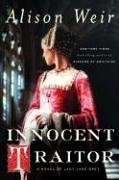
Innocent Traitor
Author: Alison Weir
Genre: Historical Fiction
Date Read: October 2009
5/5 stars
I loved this book! Before reading it I knew a bit about Jane Grey but didn't know the whole story. Weir kept to the facts but added a lot of "could have happened" moments that made me love the book.
My favorite part? The last chapter. It was amazing to me that, while I knew the history and how the book would end, the last chapter stunned me. It was perfectly wrapped up and a book I'd recommend to anyone whether they are as Tudor-obsessed as I am or not. A truly great read.
The Pillars of the Earth
Author: Ken Follett
Genre: Historical Fiction
Date Read: November 2009
3/5 stars
There were parts of this book that I could have easily given 5 stars... and there were also parts of it I could have just as easily given 1.
I really liked the characters of Prior Philip, Aliena, Jack and Ellen. And I really hated William Hamleigh and Waleran Bigod. I have read books before in which I felt a stronger connection with the 'good' characters but never before have I despised the villians as I did in this book. The brutality was sickenening and there were literally times when I covered my mouth, feeling nauseous, and had to force myself to keep going - the murders and rapes and savagery... not to mention the animal abuse! That being said, it was a brutal time and I think it gave the novel a stronger ring of truth and was therefore justified; if a little too graphic.
I also enjoyed reading about the building of the cathedrals and the basic history of a time of which I know little of. In that way especially it was a good read for me as it's interested me enough to make me want to learn more about the era, whether through another historical fiction novel or something non-fiction.
What drove me nuts about this book is how many times the story was concluded and then restarted with yet another problem. It felt like it was never going to end. There was a problem. The problem was solved. There was another problem. That problem was so solved. And so on. I felt it was much longer than it needed to be and actually sighed and rolled my eyes a couple of times when this happened. A GR friend of mine said that this book bothered him because of all the happy coincidences. The happy coincidences were fine with me - it was the exasperating problems were what bothered me.
All in all, I'm glad I read the book. I didn't love it but I liked it enought that I will read try to read its sequel, World Without End, in the upcoming year. At the same time, if I don't get to it until 2011... well, I'll be okay with that too.
Quote from book:
"In both cases, weaknesses and scruples had defeated strength and ruthlessness. He felt he would never understand it"
Thursday, February 10, 2011
The Borgia Bride
Author: Jeanne Kalogridis
Genre: Historical Fiction
Date Read: March 2010
I've been debating whether I should give this book 3 or 4 stars and I've decided on 4 because I really can't think of anything that I didn't enjoy about it. I loved the writing style and the characters, or in the case of many in this novel, loved to hate them.
This is my first time reading about the Borgias and I can't wait to get my hands on more about them. I thought the Tudors were corrupt!
What really amazed me was the afterward in this novel claiming that most of what was written actually happened. I've only done a small amount of research outside of this novel so I'm not sure if this is the case or not but from what I can see, it seems to be true. This is a novel full of murder, betrayal, incest, rape, secrets, lies and corruption surrounding not only a royal family but, at the head of it all, sits a Pope, as well. A must-read for my HF-loving friends :)
The Confessions of Catherine de Medici
Author: C. W. Gortner
Genre: Historical Fiction
Date Read: January 2011
4.5 stars
This is one of the best HF's I've ever read. I was hooked from the very beginning, couldn't put it down and didn't want it to end.
The novel starts out with Catherine as a young girl in Italy, leads to her marriage in France to Henri (the second son of King Francis I), her role as the Dauphine, as the Queen of France and then finally as the Queen Mother. She stops at nothing to keep her family and country safe.
I'm so thankful that this was my introduction to Catherine de Medici, her life and the other major players in France at the time. C.W. Gortner brought Spain and France alive for me and had me constantly looking up the people, the places and the battles, wanting to learn all I could. And how refreshing to read a historical novel in which I actually don't know the outcome. I had no idea what was going to come next and although the Tudors and England will always be my favorites, I have found a new love for the French royals, as well.
This may be my first read on Catherine de Medici and the first book I've read by C.W. Gortner but it won't be my last of either.
Subscribe to:
Posts (Atom)